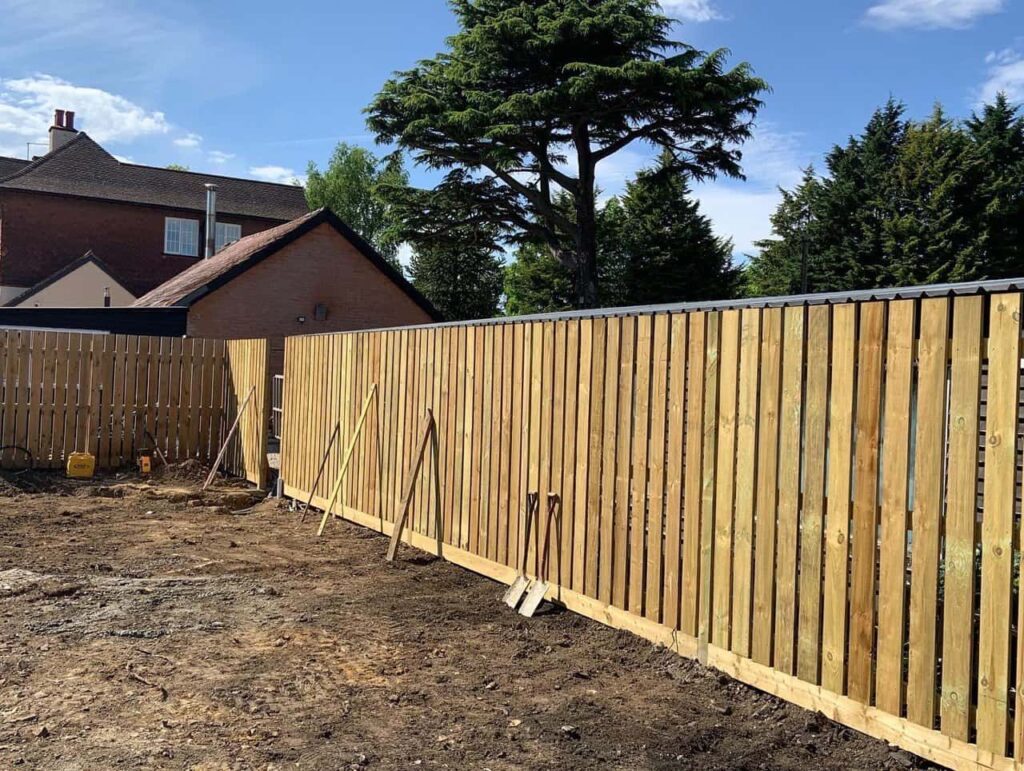
Fence Repair or Replacement: How to Know Which Option Is Best
A damaged fence does not always require complete replacement. Individual panels, posts, rails or boards can often be repaired when the surrounding structure remains stable. The decision becomes more complicated when deterioration affects several connected components or extends along much of the boundary.
Understanding the difference between localised damage and wider structural failure helps prevent repeated repairs that do not resolve the underlying problem. For property owners in Impington, Cambridge, a professional fencing assessment can establish whether repair remains practical or replacement would provide a more dependable result.
How to Decide Whether a Fence Can Be Repaired
The visible damage is only one part of the assessment. The condition of the posts, rails, fixings and surrounding ground must also be examined because these components work together to keep the fence upright.
When Is a Fence Usually Repairable?
Repair is generally suitable when damage is confined to one or two components and the main structure remains secure. Common repairable problems include:
- A single cracked or broken board
- One damaged fence panel
- A loose rail
- A small number of missing fixings
- Minor movement in one post
- Localised impact damage
- A gate that has dropped out of alignment
Replacing or securing the affected component may restore the fence without disturbing sound sections elsewhere.
Are the Fence Posts Still Sound?
Posts provide the main structural support. A damaged panel can be replaced relatively easily, but a fence will remain unstable if the posts are rotten, cracked or moving in the ground.
Check for posts that lean, wobble when the fence moves or show deterioration near ground level. If one post has failed but the others remain sound, a localised repair may be possible. Widespread post failure usually indicates that the fence has reached the point where broader replacement should be considered.
Has Rot Spread Through the Timber?
Surface weathering does not necessarily mean timber has lost its strength. However, soft, crumbling or deeply split wood suggests that deterioration has progressed beyond the outer surface.
Rot often develops around the base of timber posts, the ends of rails and areas that retain moisture. If fixings no longer hold securely or several components can be easily broken apart, patching the visible damage is unlikely to produce a durable repair.
Are Several Panels Failing Together?
One damaged panel may result from an isolated impact or exposure to strong wind. Multiple panels that are splitting, bowing or detaching at the same time suggest more general deterioration.
Replacing panels individually may not be practical if the rails, posts and neighbouring sections are also weakened. The fence should be assessed as a complete system rather than as a collection of separate panels.
Have the Rails Lost Their Strength?
Rails connect the fence boards or panels to the posts. When they rot, split or pull away, the fence can sag even if the visible boards appear serviceable.
A single rail can often be replaced. If several rails have failed along the boundary, their condition may reflect the age and deterioration of the entire structure. New boards fixed to weak rails will not remain secure.
Is the Fence Leaning Along Its Full Length?
Localised leaning may be caused by one failed post or disturbed footing. A fence that leans across several bays may have multiple weakened posts, unsuitable foundations or movement in the surrounding ground.
Straightening the panels without addressing the supports will usually provide only a temporary improvement. Each post and footing must be checked to determine how far the problem extends.
Are Fixings Repeatedly Pulling Out?
Loose nails, screws and brackets can often be renewed. Repeated fixing failure, however, may indicate that the timber around them has softened or split.
Moving a fixing to a nearby position may not help if the surrounding wood can no longer hold it securely. Where this problem occurs throughout the fence, replacement of the affected structural components may be necessary.
Has Storm Damage Exposed Existing Weakness?
Strong winds can break panels or push a fence out of alignment, but the weather may not be the only cause. A sound fence is generally better able to resist movement than one already affected by rot, loose fixings or weakened posts.
After storm damage, the inspection should cover adjoining sections. Repairing only the most obvious broken panel may leave unstable posts or rails untouched.
Is the Gate Affecting the Fence Structure?
A gate places additional weight and movement on its supporting posts. If it repeatedly drops, drags or fails to close, the issue may lie with the hinges, frame or post rather than the gate alone.
Local repairs may correct minor alignment problems. If the supporting post has deteriorated or the surrounding fence moves whenever the gate is used, more extensive work will be needed.
Are Repairs Becoming Frequent?
Occasional maintenance is normal, particularly after severe weather or accidental damage. Concern arises when one repair is quickly followed by another nearby.
Repeated failures often show that several components are reaching a similar condition. At this stage, continuing to replace individual boards, rails or fixings may not restore the stability of the complete fence.
When Does Replacement Become the Better Option?
Replacement may be more appropriate when:
- Many posts are rotten or unstable
- Several panels and rails have deteriorated
- The fence leans across a substantial length
- Fixings will no longer hold in the timber
- Previous repairs repeatedly fail
- The structure no longer provides suitable privacy or security
- Different patched sections no longer work together effectively
Complete replacement is not always required. A professional contractor may recommend renewing one continuous section while retaining parts of the boundary that remain structurally sound.
Why a Professional Assessment Helps
A fencing contractor can identify whether the visible defect is isolated or connected to wider deterioration. The assessment should examine posts, footings, rails, panels, fixings and gates.
This provides a clear basis for deciding between repair, partial replacement and full renewal. It also helps ensure that new components are not attached to weak materials that will soon fail.
Conclusion
A fence is usually suitable for repair when the damage is localised and its posts, rails and neighbouring sections remain sound. Replacement becomes more appropriate when deterioration is widespread, the structure leans across several bays or repairs continue to fail.
Fast Fix Fencing Impington can assess damaged fencing and recommend a suitable repair or replacement approach. If your fence has become unstable or severely weathered, contact our team in Impington, Cambridge, to arrange an inspection.
Call us on: 01223 912 290
Click here to find out more about Fast Fix Fencing Impington
Click here to complete our contact form and see how we can help with your fencing needs.